
Read our students on AI
There has been a lot of debate about artificial intelligence on campus lately, and our students are caught in the crossfire. But they often seem to have a clearer understanding of what is going on than the people empowered to make decisions on their behalf. On our blog, we've just published two student essays:
- "Beyond Binary Ethics in AI Discourse" by Kadallah Burrowes recounts the experience of trying to develop an ethical AI system for a MEDLab research project, and the challenges that arose along the way. It's a powerful and detailed exploration of how trying to do the right thing is harder than it should be.
- "Wired and Unwell" by Jadyn Turbeville reflects on a discussion we had on AI and mental health, raising concerns about what appears to be an increasing reliance among students on chatbots for therapeutic needs.
MEDLab director Nathan Schneider has also been writing on the topic lately, including a story about "a defunct email service as a template for campus AI" on his personal blog and, at The Conversation, an explainer on how Pope Leo XIV's new encyclical could reshape the AI industry.
Magic Mountain Talks: Jeff Sharlet on our slow civil war, in conversation with Nathan Schneider
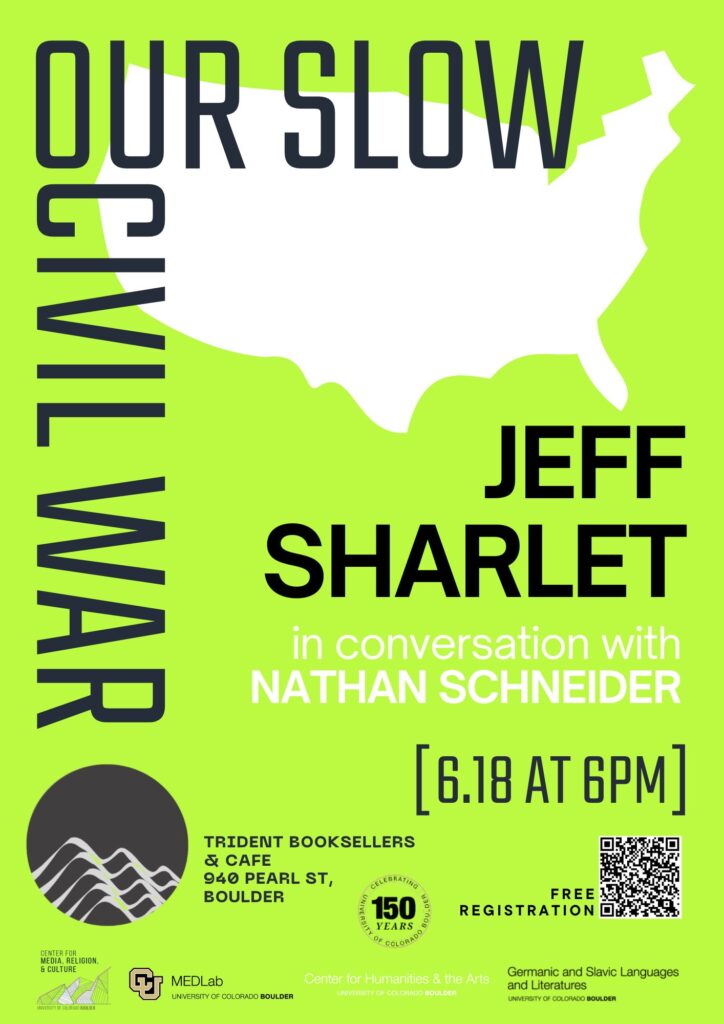 June 18, 2026
6:00 p.m. to 8:00 p.m.
MEDLab, along with collaborators on and off campus, is helping to build a new event series around the intersection of literature and politics. The events take place at Trident Booksellers & Cafe, an employee-owned business. This month:
Jeff Sharlet is the New York Times bestselling author or editor of eight books. His latest is The Undertow: Scenes from a Slow Civil War (2023), a National Book Critics Circle Award Finalist for Nonfiction, one of The New York Times 100 Books of the Year, and a New Republic book of the year. In 2020, he published This Brilliant Darkness: A Book of Strangers. “Gorgeous,” says The New York Times, “[t]he book ingeniously reminds us that all of our lives — our struggles, desires, grief — happen concurrently with everyone else’s, and this awareness helps dissolve the boundaries between us.” Sharlet’s other books include Sweet Heaven When I Die, C Street, The Family — the basis for a 2019 Netflix documentary series, The Family, of which he is narrator and executive producer — and, with Peter Manseau, Killing the Buddha;and two edited volumes, Radiant Truths, and (with Manseau) Believer, Beware. His writing on Russia’s anti-LGBTQ crusade earned the National Magazine Award for Reporting, and his writing on anti-LGBT campaigns in Uganda earned the Molly Ivins Prize and the International Gay and Lesbian Human Rights Commission’s Outspoken Award, among others. He has also been the recipient of numerous fellowships from MacDowell. Sharlet is an editor-at-large for VQR, and is or has been a contributing editor for Vanity Fair, Harper’s and Rolling Stone, and a contributor to publications including The New York Times Magazine, GQ, Esquire, Mother Jones, Bookforum, and others. At Dartmouth College, he is the publisher of 40 Towns and is the Frederick Sessions Beebe ’35 Professor in the Art of Writing.
Nathan Schneider is an associate professor of media studies at the University of Colorado Boulder, where he leads the Media Economies Design Lab. His most recent book is Governable Spaces: Democratic Design for Online Life.
Liberatory Media Residency and call for conference abstracts
Our friends at CU Boulder's Center for Media, Religion and Culture have announced a forthcoming conference on “Why We Come Together”: Media, Religion, and Community, featuring Fred Moten and Stefano Harney as keynote speakers. It will be in October in Boulder. Learn more and submit abstracts here by May 30.
The CMRC is also hosting a Liberatory Media Residency, which offers a $25,000 stipend for creators working at the intersection of religion and liberation. Apply by June 1. Get the details here.
Podcast: Who owns the commons?
 MEDLab's radio show, Looks Like New, comes out the fourth Thursday of every month on KGNU, 88.5 FM, or online as a podcast. Last month's episode is now available:
MEDLab research fellow Kadallah Burrowes speaks with Lauren Gardner, Executive Director of Open Source Collective, about what it means to build infrastructure for the commons and why the lessons of grassroots arts spaces might hold the key to the future of collective digital life. Gardner stewards a network of over 2,500 open-source and community-driven projects, providing fiscal sponsorship and shared infrastructure to thousands of maintainers and contributors worldwide.
Her path to the global open-source movement runs through some of the most generative DIY spaces in recent memory: Babycastles, the New York arcade-turned-social-gallery that reimagined game culture, and the School for Poetic Computation, where code, critical theory, art, and collaborative practice converge. Their conversation asks what artists, technologists, and anyone interested in working collectively might learn from decades of building environments where creativity and the commons come first.
Subscribe today on Apple Podcasts, Spotify, or directly through our website. You can also follow the show on Instagram, Mastodon, and X.
